LL-37 is the only cathelicidin in humans: a 37-residue antimicrobial peptide cut from the protein hCAP18, which neutrophils store and skin makes at wounds. Vitamin D switches its gene on.1,7,9,11
Beyond killing microbes it signals to immune cells, and it is implicated in psoriasis and rosacea. Two placebo-controlled trials tested it on hard-to-heal leg ulcers; the larger one found no overall benefit. It is not approved anywhere.13,14,15,16
37
4493.3 g/mol
No overall benefit
Nowhere
Identity
| Value | |
|---|---|
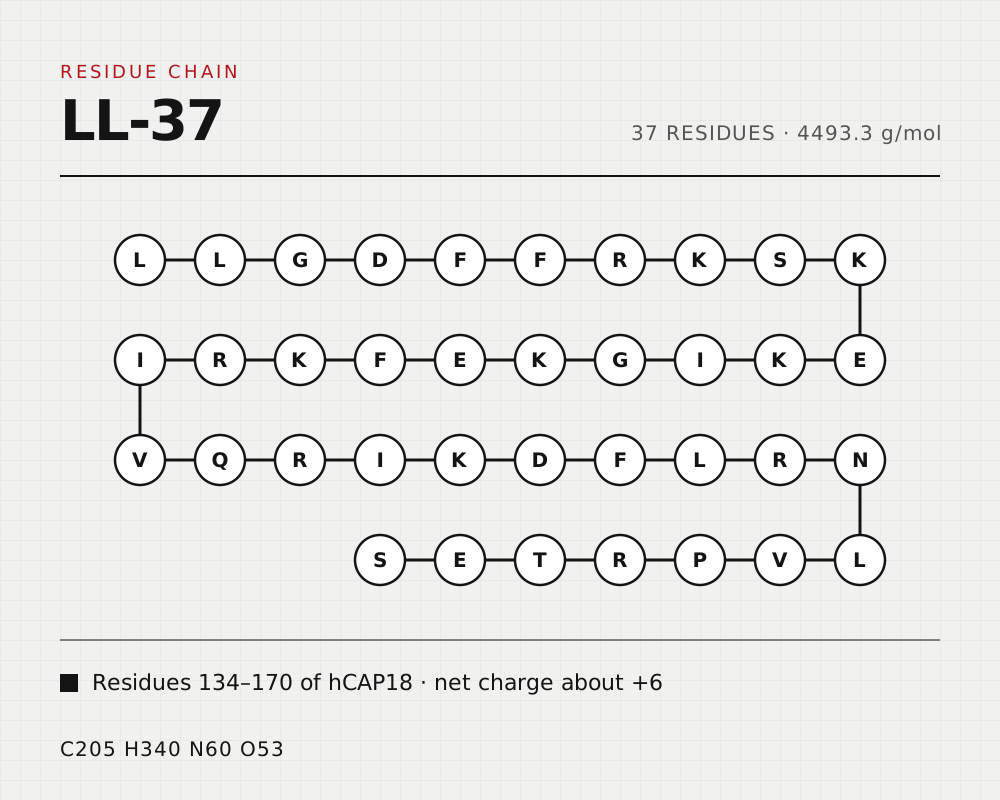
| Sequence | LLGDFFRKSKEKIGKEFKRIVQRIKDFLRNLVPRTES, residues 134–170 of hCAP181 |
| Formula | C205H340N60O532 |
| Mass | 4493.3 g/mol2 |
| Gene | CAMP; a direct target of the vitamin D receptor11 |
| Made by | Neutrophils (stored as hCAP18, cut by proteinase 3) and epithelia, including wound-edge skin5,7,9 |
| Structure | Forms an amphipathic helix on membranes; net charge about +62 |
| CAS | 154947-66-72 |
History
Four groups describe the peptide and its precursor in bone marrow and neutrophils.3,4,5
Processing to the mature peptide shown; named LL-37.6
Mice lacking their cathelicidin get worse skin infections.8
Linked to re-epithelialisation of wounds and to new blood vessel growth.9,10
Vitamin D shown to induce it, including against tuberculosis.11,12
First placebo-controlled trial in venous leg ulcers.15
Larger phase IIb leg-ulcer trial finds no overall benefit.16,20
FDA removes it from its list of compounding substances with safety concerns after the nominations were withdrawn; an advisory review is planned.18
What the studies measured
| Study | Model | What was measured | Result | Source |
|---|---|---|---|---|
| Nizet 2001 | Mice lacking cathelicidin | Skin infection | More invasive streptococcal infection | [8] |
| Heilborn 2003 | Human skin wounds | Peptide at the wound edge | Present in healing epidermis, missing from chronic ulcers | [9] |
| Grönberg 2014 | 34 with venous leg ulcers, 4 weeks | Healing rate, safety | Faster healing at the lowest concentration; highest no different from placebo; no safety concerns | [15] |
| Mahlapuu 2021 | 148 with venous leg ulcers, 13 weeks | Complete wound closure | No significant benefit overall; a post hoc subgroup with large wounds healed more | [16] |
| Miranda 2023 | 25 with diabetic foot ulcers | Granulation, inflammation markers | More granulation; inflammation and bacterial counts unchanged | [17] |
The peptide also drives inflammation: complexes of LL-37 with the body's own DNA activate immune cells in psoriasis, and excess processed cathelicidin is found in rosacea.13,14
Regulatory and sport status
As of this revision.
| Where | Status |
|---|---|
| US | Not approved. Listed by FDA as a compounding substance with safety concerns from 2023 until April 2026, when it was removed after the nominations were withdrawn; FDA notes immunogenicity and other risks, and an advisory committee review is planned.18 |
| EU and UK | Not authorised. |
| Sport | Not named on the 2026 WADA list. As an unapproved substance it probably falls under class S0.19 |
Open questions
Common questions
Is LL-37 made by the body?
Yes. The CAMP gene encodes it, and it is cut from hCAP18 in neutrophils and skin.
Why is it linked to vitamin D?
The CAMP gene is a direct target of the vitamin D receptor.
Is it an approved drug?
No, not in the US, EU or UK.
What did the largest trial find?
No overall benefit on leg-ulcer healing; a post hoc subgroup with large wounds did better.
Is it banned in sport?
It is not named, but as an unapproved substance it probably falls under WADA class S0.
See also
References
- UniProt. P49913 (CAMP_HUMAN), checked 3 Nov 2026. uniprot.org
- PubChem. LL-37, CID 16198951, checked 3 Nov 2026.
- Agerberth B, et al. FALL-39, a putative human peptide antibiotic, is cysteine-free and expressed in bone marrow and testis. Proc Natl Acad Sci USA. 1995;92(1):195–199. PMID 7529412
- Larrick JW, et al. Human CAP18: a novel antimicrobial lipopolysaccharide-binding protein. Infect Immun. 1995;63(4):1291–1297. PMID 7890387
- Cowland JB, et al. hCAP-18, a cathelin/pro-bactenecin-like protein of human neutrophil specific granules. FEBS Lett. 1995;368(1):173–176. PMID 7615076
- Gudmundsson GH, et al. The human gene FALL39 and processing of the cathelin precursor to the antibacterial peptide LL-37 in granulocytes. Eur J Biochem. 1996;238(2):325–332. PMID 8681941
- Sørensen OE, et al. Human cathelicidin, hCAP-18, is processed to the antimicrobial peptide LL-37 by extracellular cleavage with proteinase 3. Blood. 2001;97(12):3951–3959. PMID 11389039
- Nizet V, et al. Innate antimicrobial peptide protects the skin from invasive bacterial infection. Nature. 2001;414(6862):454–457. PMID 11719807
- Heilborn JD, et al. The cathelicidin anti-microbial peptide LL-37 is involved in re-epithelialization of human skin wounds and is lacking in chronic ulcer epithelium. J Invest Dermatol. 2003;120(3):379–389. PMID 12603850
- Koczulla R, et al. An angiogenic role for the human peptide antibiotic LL-37/hCAP-18. J Clin Invest. 2003;111(11):1665–1672. PMID 12782669
- Gombart AF, et al. Human cathelicidin antimicrobial peptide (CAMP) gene is a direct target of the vitamin D receptor. FASEB J. 2005;19(9):1067–1077. PMID 15985530
- Liu PT, et al. Toll-like receptor triggering of a vitamin D-mediated human antimicrobial response. Science. 2006;311(5768):1770–1773. PMID 16497887
- Lande R, et al. Plasmacytoid dendritic cells sense self-DNA coupled with antimicrobial peptide. Nature. 2007;449(7162):564–569. PMID 17873860
- Yamasaki K, et al. Increased serine protease activity and cathelicidin promotes skin inflammation in rosacea. Nat Med. 2007;13(8):975–980. PMID 17676051
- Grönberg A, et al. Treatment with LL-37 is safe and effective in enhancing healing of hard-to-heal venous leg ulcers: a randomized, placebo-controlled clinical trial. Wound Repair Regen. 2014;22(5):613–621. PMID 25041740
- Mahlapuu M, et al. Evaluation of LL-37 in healing of hard-to-heal venous leg ulcers: a multicentric prospective randomized placebo-controlled clinical trial. Wound Repair Regen. 2021;29(6):938–950. PMID 34687253
- Miranda E, et al. Efficacy of LL-37 cream in enhancing healing of diabetic foot ulcer: a randomized double-blind controlled trial. Arch Dermatol Res. 2023;315(9):2623–2633. PMID 37480520
- US Food and Drug Administration. Certain bulk drug substances for use in compounding that may present significant safety risks (current as of 22 April 2026), and Pharmacy Compounding Advisory Committee early announcement, 15 April 2026. fda.gov
- World Anti-Doping Agency. The 2026 Prohibited List (in force 1 January 2026). wada-ama.org Class S0.
- Promore Pharma. Results from the phase IIb study HEAL LL-37 of ropocamptide in venous leg ulcers, 19 November 2020, and clarification, 20 November 2020. mfn.se
Peptidarium Library. LL-37 (entry 0031), revision 1.0, 2 November 2026. peptidarium.com/library/ll-37
Revision history
| Rev | Date | Change | By |
|---|---|---|---|
| 1.0 | 2 Nov 2026 | Entry created. | [Scientific editor] |
Spotted an error or a missing paper? Send a correction. Every change is logged here.