SS-31 is a four-residue peptide that concentrates in the inner membrane of mitochondria and binds cardiolipin, a lipid found almost only there. It was designed by Hazel Szeto and Peter Schiller and is known in medicine as elamipretide.1,2,3
Its trials in heart attack, mitochondrial myopathy and macular degeneration missed their main goals. In September 2025 the FDA gave it accelerated approval as Forzinity for Barth syndrome, a rare inherited disease of cardiolipin, on the basis of muscle strength.4,7,8,10
4
639.8 g/mol
Barth syndrome
US, 2025
Identity
| Value | |
|---|---|
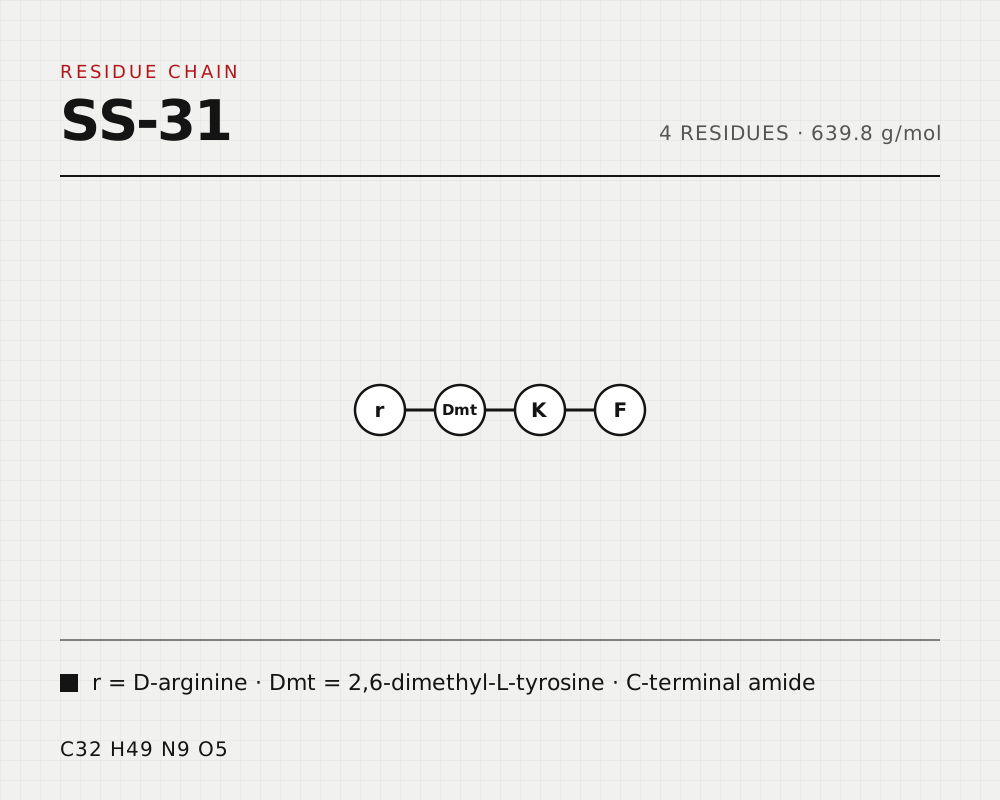
| Sequence | D-Arg-Dmt-Lys-Phe-NH2; Dmt is 2,6-dimethyl-L-tyrosine11 |
| Formula | C32H49N9O5 (free base); the medicine is the hydrochloride11,12 |
| Mass | 639.8 g/mol (free base)12 |
| CAS | 736992-21-512 |
| Target | Cardiolipin in the inner mitochondrial membrane2,11 |
| Origin | Szeto-Schiller peptides, Weill Cornell1,3 |
History
First paper: peptide antioxidants that concentrate in the inner mitochondrial membrane.1
Shown to bind cardiolipin.2
EMBRACE STEMI: no reduction in heart-attack size.4
TAZPOWER in Barth syndrome published; randomised endpoints missed, extension showed gains.5
MMPOWER-3 in mitochondrial myopathy misses both main endpoints.7
FDA accelerated approval as Forzinity for Barth syndrome, with a confirmatory trial required.9,10
Confirmatory trial 4TAZPower starts; dry macular degeneration phase 3 continues.13
What the trials measured
| Trial | People | Main measure | Result | Source |
|---|---|---|---|---|
| EMBRACE STEMI | Heart attack treated with PCI | Infarct size (CK-MB) | No significant reduction | [4] |
| TAZPOWER | 12 with Barth syndrome, crossover then extension | 6-minute walk, fatigue | Missed in the randomised part; walk distance up about 96 m in the open extension | [5],[6] |
| MMPOWER-3 | 218 with primary mitochondrial myopathy | 6-minute walk, fatigue | Missed both (walk difference −3.2 m) | [7] |
| ReCLAIM-2 | 176 with dry macular degeneration | Low-light vision, lesion growth | Missed both; a secondary retinal measure slowed | [8] |
The approval rests on knee-extensor strength, an intermediate endpoint, so a randomised confirmatory trial is required. Injection-site reactions were the most common side effect.10,11
Regulatory and sport status
As of this revision.
| Where | Status |
|---|---|
| US | Accelerated approval (September 2025) for Barth syndrome in patients of at least 30 kg; continued approval depends on the confirmatory trial.10,11 |
| EU | Not authorised; orphan designations for Barth syndrome and mtDNA depletion.14 |
| UK | Not authorised. |
| Sport | Not named on the 2026 WADA list. Since its US approval, the unapproved-substance class S0 may not apply; status not settled.15 |
Open questions
Common questions
Is SS-31 the same as elamipretide?
Yes. SS-31 is the research code, elamipretide the international name and Forzinity the US brand.
Is it approved?
Only in the US, under accelerated approval, for Barth syndrome.
How does it work?
It binds cardiolipin in the inner mitochondrial membrane.
Did it work in mitochondrial myopathy?
No. MMPOWER-3 missed both of its main endpoints.
What does SS stand for?
Szeto-Schiller, after the two scientists who designed the peptide family.
See also
References
- Zhao K, et al. Cell-permeable peptide antioxidants targeted to inner mitochondrial membrane inhibit mitochondrial swelling, oxidative cell death, and reperfusion injury. J Biol Chem. 2004;279(33):34682–34690. PMID 15178689
- Birk AV, et al. The mitochondrial-targeted compound SS-31 re-energizes ischemic mitochondria by interacting with cardiolipin. J Am Soc Nephrol. 2013;24(8):1250–1261. PMID 23813215
- Szeto HH. First-in-class cardiolipin-protective compound as a therapeutic agent to restore mitochondrial bioenergetics. Br J Pharmacol. 2014;171(8):2029–2050. PMID 24117165
- Gibson CM, et al. EMBRACE STEMI study: a phase 2a trial to evaluate the safety, tolerability, and efficacy of intravenous MTP-131 on reperfusion injury. Eur Heart J. 2016;37(16):1296–1303. PMID 26586786
- Thompson WR, et al. A phase 2/3 randomized clinical trial followed by an open-label extension to evaluate the effectiveness of elamipretide in Barth syndrome. Genet Med. 2021;23(3):471–478. PMID 33077895
- Thompson WR, et al. Long-term efficacy and safety of elamipretide in patients with Barth syndrome: 168-week open-label extension results of TAZPOWER. Genet Med. 2024;26(7):101138. PMID 38602181
- Karaa A, et al. Efficacy and safety of elamipretide in individuals with primary mitochondrial myopathy: the MMPOWER-3 randomized clinical trial. Neurology. 2023;101(3):e238–e252. PMID 37268435
- Ehlers JP, et al. ReCLAIM-2: a randomized phase II clinical trial evaluating elamipretide in age-related macular degeneration. Ophthalmol Sci. 2025;5(1):100628. PMID 39605874
- Shirley M. Elamipretide: first approval. Drugs. 2026;86(3):377–383. PMID 41335372
- US Food and Drug Administration. FDA grants accelerated approval to first treatment for Barth syndrome. 19 September 2025. fda.gov
- FORZINITY (elamipretide hydrochloride) injection, US prescribing information. 2025. dailymed.nlm.nih.gov
- PubChem. Elamipretide, CID 11764719, checked 3 Nov 2026.
- ClinicalTrials.gov records NCT03098797, NCT03323749, NCT06373731 and NCT07531251, checked 3 Nov 2026.
- European Medicines Agency. Orphan designations EU/3/21/2430 and EU/3/22/2614. ema.europa.eu
- World Anti-Doping Agency. The 2026 Prohibited List (in force 1 January 2026). wada-ama.org
Peptidarium Library. SS-31 (entry 0030), revision 1.0, 2 November 2026. peptidarium.com/library/ss-31
Revision history
| Rev | Date | Change | By |
|---|---|---|---|
| 1.0 | 2 Nov 2026 | Entry created. | [Scientific editor] |
Spotted an error or a missing paper? Send a correction. Every change is logged here.